

A single product reference may arrive at the warehouse multiple times, often at varying costs. Weighted Average Price (WAP) is an inventory valuation method used to calculate the average cost of available units based on both the purchase price and the quantity of each intake. This value directly impacts the cost of goods sold (COGS), reported margins, and end-of-period inventory valuation. In retail, where procurement overlaps with sales across physical stores, e-commerce, and other channels, maintaining consistent stock valuation is critical. This article breaks down what WAP is, how to calculate it, and how it differs from FIFO and LIFO.
What weighted average price is and what it is used for in accounting
In retail, purchasing the same item multiple times a year at fluctuating prices is standard practice. Costs vary due to supplier terms, associated shipping or handling expenses, or price shifts between orders. The Weighted Average Price method calculates a single average cost for these units by factoring in the price and quantity of each transaction. Consequently, larger inventory entries carry more weight, resulting in a balanced, uniform value for all available stock. Under standard accounting frameworks like Spain's Plan General de Contabilidad, weighted average cost is the general standard for valuing interchangeable goods. In short, it provides a consistent method for determining book value, even when inventory is acquired at different price points.
Weighted average price formula
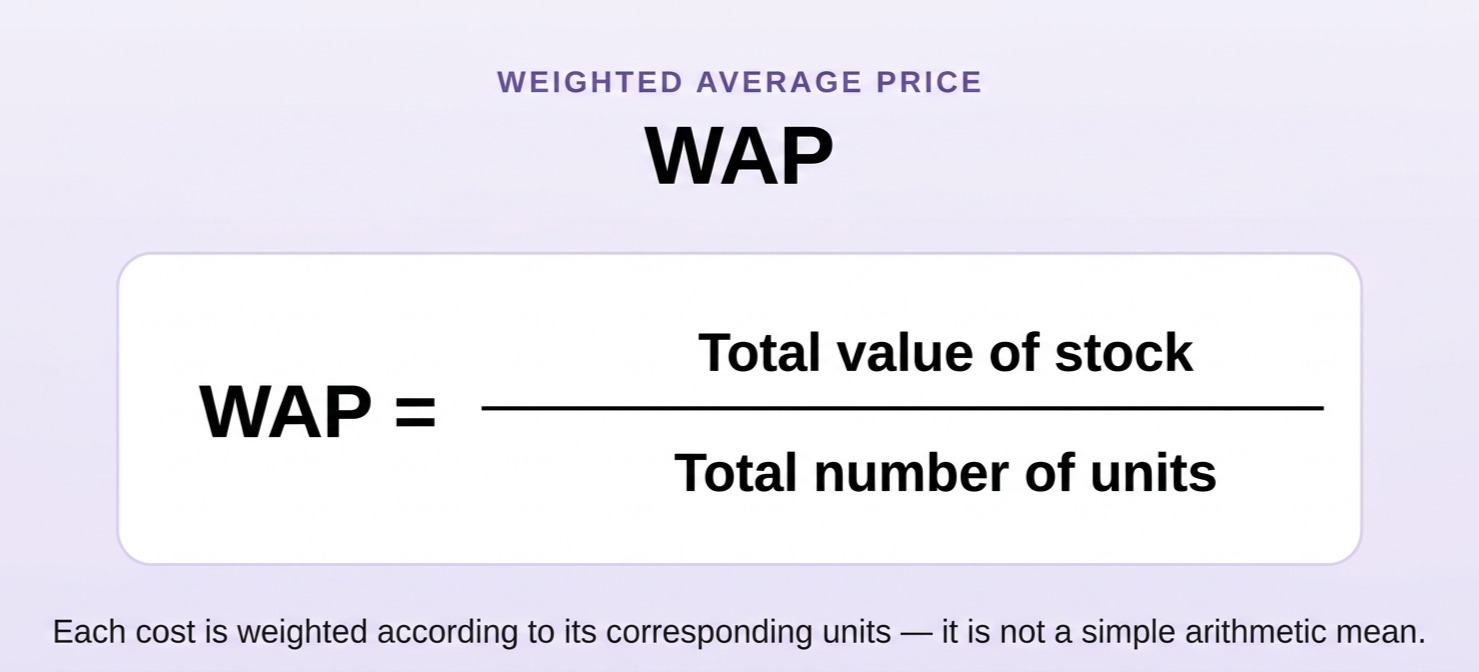
The WAP formula calculates the ratio of the total value of available inventory to the total number of units in stock. It is not a simple arithmetic mean of purchasing prices; every acquisition cost must be weighted according to its corresponding unit volume.
Variables involved in the calculation
Calculating Weighted Average Price requires tracking the unit count for each incoming shipment, its unit cost, and the cumulative inventory value. From an accounting standpoint, the acquisition cost may include directly attributable expenses incurred to bring items to their sales location, while discounts and promotions must be factored in according to relevant regulations. For enterprise retailers operating across multiple suppliers, warehouses, POS locations, and international markets, real-time stock visibility and unified inventory management are essential for maintaining accurate, consistent stock data.
How to calculate WAP step by step with a practical example
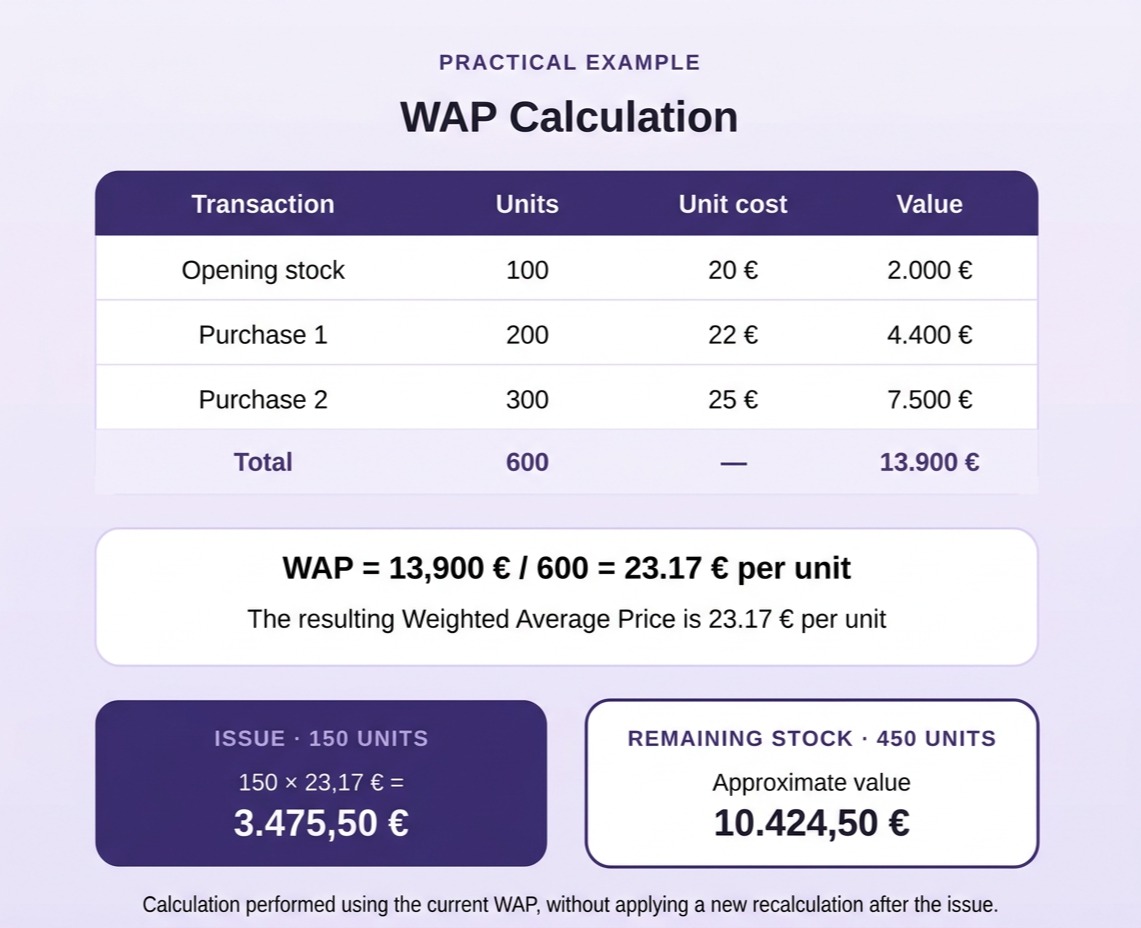
Let’s look at a simple practical example for a product reference receiving several inventory intakes at different costs. In real-world retail operations involving thousands of SKUs and high transaction volumes, maintaining data consistency across procurement, store fulfillment, returns, and inventory transfers is paramount.
Example with multiple stock entries at different prices
What moving weighted average price is and how it differs from periodic WAP
Weighted Average Price can be calculated on a moving (perpetual) or periodic basis. The primary distinction lies in when inventory costs are updated:
- Moving WAP: The average cost is recalculated with every new stock entry. If a shipment arrives at a different price, a new WAP is immediately applied to all available units.
- Periodic WAP: The calculation occurs at the end of a specific period, factoring in beginning inventory and all intake entries recorded throughout that timeframe.
This distinction is especially crucial for enterprise retailers with high SKU counts and rapid stock turnover. The higher the update frequency, the more vital real-time integration becomes across ERP, OMS, WMS, and POS systems.
Weighted average price vs. FIFO and LIFO: which valuation method to choose
Inventory valuation methods determine which costs are assigned to goods sold and which remain tied to ending inventory. WAP, FIFO, and LIFO apply different criteria when procurement costs fluctuate, directly impacting financial statements.
What is the FIFO method?
The FIFO method (First In, First Out) assumes that the earliest inventory acquired is sold first. Consequently, COGS reflects older acquisition prices, while ending inventory is valued at current, more recent costs. FIFO is fully compliant under both international standards (IAS 2) and Spanish accounting frameworks.
What is the LIFO method?
The LIFO method (Last In, First Out) applies the opposite logic, assuming the most recently acquired units are sold first. Remaining stock is tied to older costs. However, LIFO is prohibited under IAS 2 and standard European accounting frameworks, making it unusable under these regulations.
Difference between FIFO and LIFO
The core difference between FIFO and LIFO lies in the sequence used to value inventory:
- FIFO: Follows chronological order (first items in are first out).
- LIFO: Follows reverse chronological order (last items in are first out).
During periods of price volatility, this distinction yields markedly different figures for both COGS and ending inventory value.
Difference between WAP and FIFO
The difference between WAP and FIFO lies in how acquisition prices are applied:
- WAP: Calculates an average cost per unit weighted by volume across all incoming shipments.
- FIFO: Tracks purchase batches in sequence, consuming older costs first.
WAP smooths out cost fluctuations over time, whereas FIFO reflects price changes sequentially based on sales flows.
Which valuation method should you choose?
Weighted Average Price is widely adopted as the default method for valuing interchangeable goods, though FIFO is also permitted when it better suits operational management. The choice depends on inventory characteristics and which framework offers the truest reflection of financial value—provided it is applied consistently across similar assets. LIFO, by contrast, is not permitted under IAS 2 or European regulatory standards.
How WAP affects margin, cost of goods sold, and year-end closing
Weighted Average Price directly impacts COGS, profit margins, and balance sheet valuations. When an item is sold, its current WAP dictates the sales cost. If WAP rises while retail pricing remains static, profit margins shrink; if WAP decreases, margins expand.
Furthermore, unsold units remain on the balance sheet, directly shaping end-of-year financial statements.
For retailers, this requires unified retail data across POS systems, e-commerce, store fulfillments, returns, and inventory transfers to prevent discrepancies from distorting financial reports.
Common mistakes when calculating weighted average price
While the formula is straightforward, operational scaling introduces complexity. Common pitfalls to avoid include:
- Calculating a simple arithmetic average without weighting by unit volume.
- Inputting inaccurate purchase costs or intake quantities.
- Miscalculating supplier discounts and promotions management or shipping overheads.
- Improperly recording returns/refunds or inventory transfers.
- Applying inconsistent valuation criteria across similar product categories.
- Operating on legacy systems with delayed data synchronization.
In an omnichannel retail environment, accurate WAP calculation depends on data integrity, traceability, and unified commerce architecture across all channels.
From operational data to a unified view of retail
Accurately calculating Weighted Average Price demands reliable operational data. For large retailers processing sales, store fulfillment, and returns across multi-store networks and e-commerce platforms, unified inventory data is essential for accurate inventory valuation.
Orisha Commerce provides unified commerce platform solutions designed for enterprise retailers to seamlessly connect store inventory, POS, e-commerce, and distributed order management. As an anchor of this ecosystem, Openbravo POS streamlines point-of-sale operations within a cloud-native SaaS architecture that integrates effortlessly with legacy systems, WMS, and ERPs. By eliminating data fragmentation, retailers achieve a scalable, real-time view of their entire operation. Discover how Orisha Commerce can help unify your operations and streamline retail management.