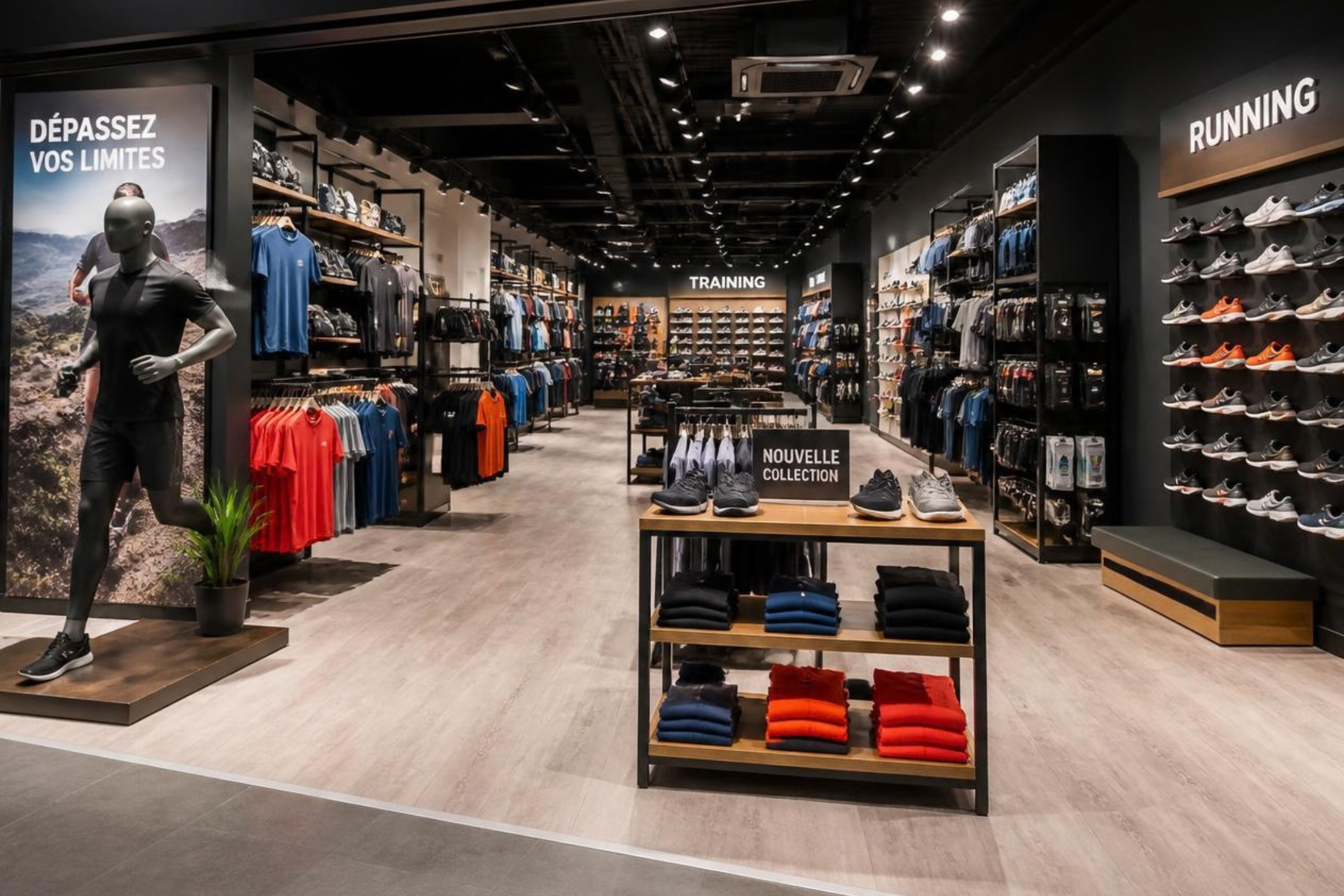
Ouvrir un magasin de sport implique de piloter un assortiment de produits qui se multiplie très vite selon les marques, catégories, tailles, couleurs et collections saisonnières. Dès que l'on y associe des ventes en e-commerce ou la gestion de plusieurs points de vente, suivre la disponibilité des articles et localiser précisément chaque référence produit devient un défi complexe. Opening a sports store means managing a product assortment that can quickly expand across brands, categories, sizes, colors, and seasons. When you add e-commerce sales or multiple store locations to the mix, keeping track of what is available and where each product is located becomes even more challenging. Running this operation efficiently requires four key technological pillars: unified stock across stores, warehouses, and e-commerce; omnichannel capabilities; a connected POS system; and centralized data. Together, they form the foundation to coordinate sales, inventory, and customer insights without relying on information silos. In this post, we will explore how to address each pillar and what to consider to manage a sports store or store network effectively.
What a sports retailer needs today to operate and stay competitive
When planning how to open a sports store, technology must meet immediate requirements while supporting projected growth. Although independent retailers and sports store chains operate on different scales, they share several core challenges:
- Managing a complex assortment: Overseeing models, sizes, colors, and seasonal collections without losing real-time stock visibility.
- Navigating seasonality: Aligning procurement and replenishment with shifting demand patterns.
- Connecting stores, warehouses, and e-commerce: Sharing order and inventory data seamlessly across all touchpoints.
- Tailoring assortments: Meeting the localized needs of each sales point.
- Centralizing data: Establishing a single source of truth for products, sales, customers, and inventory to drive smarter decision-making.
That is why, when selecting technology partners and planning IT investments, it pays to look beyond immediate requirements. Software for a sports store must integrate effortlessly with existing systems and scale to accommodate new sales channels, physical locations, or international markets as the business grows.
Bridging physical stores and e-commerce: Omnichannel strategies in sports retail
The customer journey no longer has to start and end on the same channel. A shopper might browse running shoes online, check if their size is in available inventory at a nearby store, head in to try them on, and complete the purchase right there.
To make this seamless experience a reality, physical stores and digital channels must share unified customer, inventory, order, and sales data. Connecting these touchpoints allows retailers to manage different channels as a single, cohesive operation while providing shoppers with reliable product availability information.
Unified stock across channels
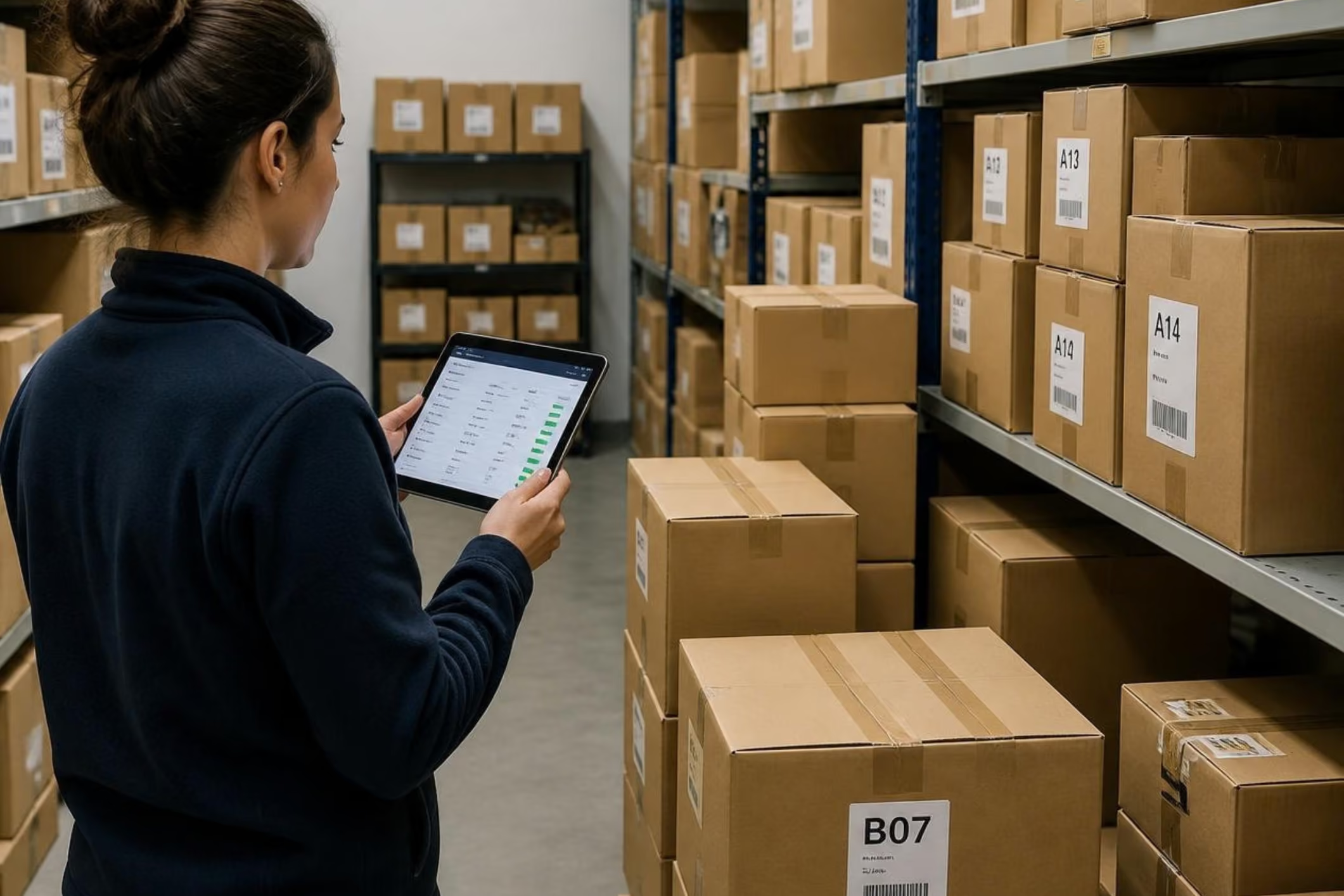
Knowing there are ten pairs of sneakers left in stock is of little value if you do not know where they are or which sizes remain available. Unified stock management must provide full visibility into every product reference and its exact location across stores and warehouses.
This real-time visibility enables you to:
- Track available inventory for every product variant.
- Determine the optimal fulfillment location for online orders (e.g., ship from store).
- Locate items for in-store shoppers from another branch in the network.
- Balance stock transfers between stores based on local demand.
In this way, network-wide available inventory is utilized far more efficiently rather than being managed in isolated channel silos.
Click & Collect and omnichannel returns
Services like Click & Collect, eReservations, or in-store returns also depend heavily on this connectivity. The system must recognize an order regardless of its point of origin and automatically update inventory levels the moment an item is collected, canceled, or returned.
In a modern omnichannel sports store, customers can move freely between touchpoints, while the retailer maintains a single, unified view of the entire operation.
Real-time stock, size, and color management
In sports retail, a single product reference can rapidly multiply across models, sizes, and colors. Consequently, simply having a product in stock does not guarantee you have the exact variant a customer is looking for.
Seasonality adds another layer of complexity. Categories such as skiing, cycling, water sports, or outdoor gear experience concentrated surges in demand, making precise stock rotation control essential to avoid stockouts during peak season or excess inventory when the season ends.
Your retail software should enable you to:
- Track stock levels by product reference, size, and color.
- Distinguish between available, reserved, or in-transit units.
- Spot potential stockouts and overstock risks quickly.
- Analyze stock rotation rates across products and variants.
- Fine-tune assortment management based on sales performance at each store location.
The ultimate goal is to maintain accurate inventory visibility to anticipate procurement and replenishment needs while minimizing slow-moving stock, particularly in seasonal categories.
POS and checkout systems connected to your operations
A POS system should never operate in isolation. Every in-store transaction must instantly reflect in inventory levels and connect seamlessly with product catalogs, pricing management, discounts and promotions, and CRM data. This eliminates manual tasks and ensures updated information across all sales points.
Openbravo POS, Orisha Commerce's point-of-sale solution, enables centralized store management and real-time tracking of sales and inventory data.
Managing a sports store chain with multiple sales points
Expanding from a single store to a multi-store network increases operational complexity beyond just managing more physical locations. It involves coordinating distributed inventory, inter-store transfers, staff schedules, pricing management, promotions, and consolidated data.
A sports store chain must strategically balance centralized control with localized adjustments for individual store needs.
Centralized stock and pricing with local adaptability
Centralized management does not mean offering the exact same product range in every location. A mountain store, for instance, requires a different selection of products, brands, or sizes compared to a flagship store in a major city.
The key lies in tailoring assortment management and stock levels to local demand while keeping product catalogs, inventory, pricing management, and sales data centralized. This approach allows you to oversee the entire retail network cohesively without sacrificing local relevance.
Reporting and store performance benchmarking
Comprehensive reporting lets you benchmark performance across different sales points and spot variances in sales, stock rotation, product availability, or assortment performance. For instance, a product category might accumulate excess inventory in one store while selling out rapidly in another.
Orisha Commerce provides centralized dashboards and store-level KPIs, delivering a unified view of your entire network's performance. Managing a sports retail chain successfully requires balancing individual store requirements with a holistic, top-level business strategy.
Customer loyalty and customer experience, in-store and online
Gaining deeper customer insights enables you to deliver personalized shopping experiences and build long-term relationships beyond one-off transactions. Achieving this requires access to unified purchase histories and preferences across both physical stores and digital channels.
In sporting goods retail, customer knowledge is particularly valuable due to recurring purchasing patterns—whether a shopper is replacing worn-out running shoes, gearing up for a new season, or purchasing complementary accessories.
These insights empower retailers to craft targeted discounts and promotions, tailored loyalty rewards, and better-informed in-store service. Ultimately, understanding individual shopping habits helps elevate the overall customer experience and drive repeat purchases.
Data-driven decision-making: Analytics and reporting in sports retail
Sales and inventory data provide actionable insights into business operations, allowing retail and operations managers to address specific challenges and answer key operational questions:
- Which sizes or product references are experiencing frequent stockouts?
- Where is slow-moving inventory piling up?
- Which products should be transferred between store locations?
- Which product categories perform best in each specific store?
Answering these questions requires working with standardized, comparable KPIs across all locations. When individual stores, warehouses, or digital channels operate with isolated data silos, evaluating network-wide performance and adapting swiftly to demand shifts becomes difficult.
Advanced analytics turns raw retail data into informed decisions regarding assortment management, automated replenishment, inventory balancing, and sales point optimization.
Manage your sports store with Orisha Commerce
As a sports retailer adds new store locations and sales channels, coordinating end-to-end retail operations becomes increasingly complex.
Orisha Commerce provides specialized retail software solutions tailored to the Sports and Outdoor sector. Its Openbravo platform seamlessly integrates POS software, inventory management, and omnichannel operations to support both standalone stores and large retail chains.
This gives sports retailers a 360-degree, unified view of sales, available inventory, and store operations, backed by a scalable solution built to grow alongside the business.
Discover Orisha Commerce's solutions to streamline and connect your retail operations.