

In the DIY sector, fulfilling a product availability promise can come down to a matter of minutes. A customer spots a drill, a paint can, or outdoor equipment online, reserves it, and visits the store for pickup. If the displayed stock level is unreliable, the sale may be canceled, hastily substituted, or rerouted to another fulfillment location. For DIY retailers, this friction is more than just a customer annoyance. It also strains store teams, increases logistics costs, complicates inter-store transfers, and undermines the profitability of omnichannel journeys. The goal is to tightly connect store stock, e-commerce, and store fulfillment to keep customer promises without disrupting daily operations.
IN SHORT
Unified commerce enables DIY retailers to manage product availability, online orders, and store fulfillment using shared real-time data. AI provides true value when helping determine the best fulfillment location, anticipate stockouts, offer product substitutions, or prioritize store tasks. However, actual gains depend on one prerequisite: reliable inventory data connected across POS software, OMS, e-commerce platforms, and fulfillment workflows.
Why does DIY make unified commerce more complex?
The DIY home improvement market imposes supply chain and omnichannel constraints on retailers that weaken the customer promise if online data is inaccurate. Three industry specifics make flow unification more complex:
- Extensive product catalogs: Managing tens of thousands of SKUs characterized by heavy, bulky items (building materials, outdoor landscaping) and high seasonality (gardening).
- Hybrid customer journeys: Online research, in-store sales assistance, Click & Collect pickup, home delivery, and returns.
- Critical inventory challenges: The continuous need to balance theoretical and physical inventory while factoring in eReservations, picking in progress, and inter-store transfers.
In DIY retail, achieving a successful omnichannel promise directly depends on the reliability and quality of real-time stock data.
What data needs to flow in real time?
To power retail software for home, furniture, and DIY chains, 7 operational data streams must converge continuously:
- Store inventory: Available for sale, web-reserved, currently picking, in-transit, and unavailable (shrinkage, damage).
- Warehouse/depot inventory: Central stock volumes used to offer delivery alternatives.
- Web and store orders: Centralization via retail order management.
- Fulfillment rules: Logistics proximity, safety stock thresholds, store workload, and customer priority levels.
- Product information: Dimensions, variants, item substitutes, and compatibility.
- Customer data: Purchase history, pickup preferences, and customer type (retail buyer vs. professional contractor).
- Operational data: Lead times, picking status, order cancellation rates, and stockout alerts.
How do you connect stock, e-commerce, and order fulfillment?
Ship from Store and Click & Collect turn points of sale into micro-warehouses, making it essential to rethink workflow orchestration. Without real-time stock tracking updated with every transaction, significant friction arises.
Journey of a successfully orchestrated order:
- The customer orders or reserves online using retail e-commerce solutions.
- The OMS (Order Management System) verifies real-time stock availability.
- Dynamic inventory allocation identifies the optimal fulfillment location (proximity, store workload).
- The task is routed to the store team.
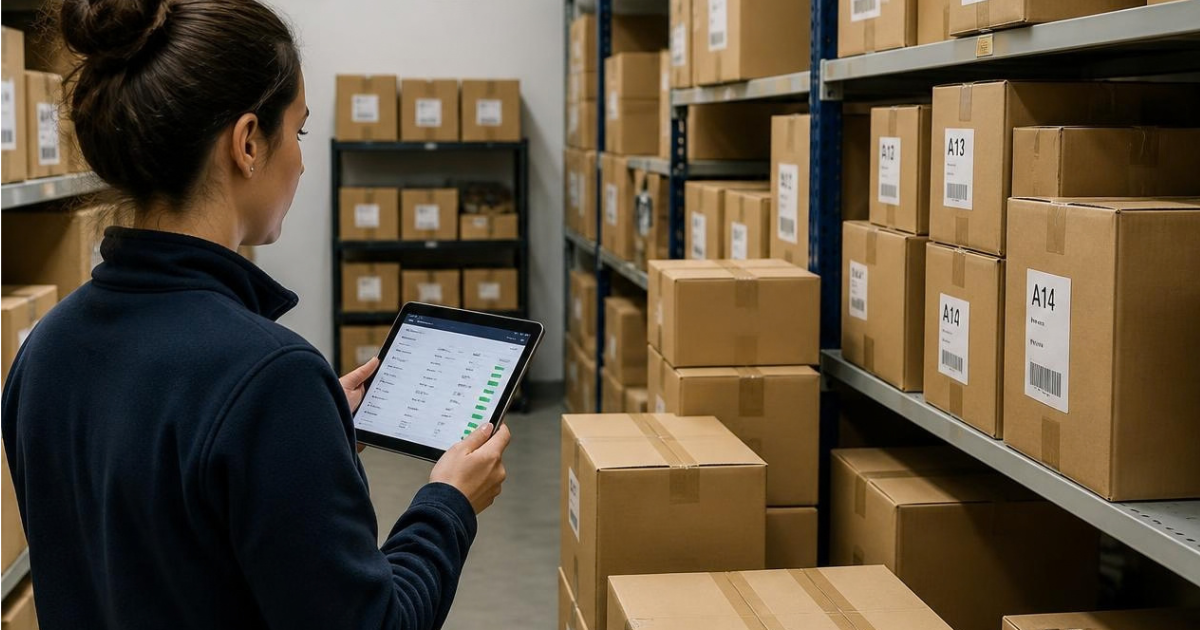
- Guided picking is executed via mobile devices (aisle routing, barcode scanning).
- The "ready" status triggers customer notifications and updates unified inventory management.
Click & Collect (instant stock hold).Ship from Store.eReservations.Sales fulfilled from another store's inventory.Item substitution in case of inventory discrepancies.
Where does AI truly add value?
AI only adds value when backed by reliable, real-time connected stock data.
What criteria should you evaluate before choosing a solution?
A retail SaaS platform for unified commerce must meet 10 technical and operational prerequisites:
- Real-time updates: Can it absorb heavy transaction volumes to avoid latency between counter sales and online displays?
- Ecosystem integration: Does it natively connect to POS, OMS, e-commerce, WMS, and ERP systems?
- Open APIs: Are they well-documented to ensure agility and long-term architecture sustainability?
- Allocation engine: Does it support easy configuration of order routing scenarios (proximity, inventory clearance)?
- Mobile workflows: Is the store associate app intuitive for team members?
- Exception management: Does it natively handle partial stockouts (reallocation, substitution, delays)?
- Multi-store scalability: Can it support the growing demands of an extensive network of large-format retail stores?
- Operational reporting: Does it offer real-time dashboards to identify supply chain bottlenecks?
- AI adaptability: Can predictive modules be added without overhauling core systems?
- Phased deployment: Does it support activation by batch or customer journey (e.g., launching Click & Collect before Ship from Store)?
For retailers aiming to make physical stores true omnichannel orchestration hubs, selecting the right POS software is decisive. A solution like Openbravo POS connects checkouts, inventory, order management, and store journeys within a unified commerce model.
Looking to evaluate whether your current POS system can support your Click & Collect, Ship from Store, or eReservation journeys? Talk to an Orisha Commerce expert.
Mini checklist: is your retail brand ready?Is store inventory visible in real time on your e-commerce platform?Does the system differentiate between available, reserved, in-picking, and in-transit stock?Do store teams receive guided store fulfillment tasks?Can online orders be fulfilled across multiple physical stores?Do allocation rules account for inventory availability, proximity, and store workload?Do stockouts automatically trigger substitutions or re-allocation?Are fulfillment KPIs tracked on a store-by-store basis?
Quels KPI suivre pour mesurer le ROI ?
Tracking targeted metrics allows you to measure the impact of unified commerce and prove ROI.
Warning: common mistakes to avoid
- Displaying e-commerce inventory that is not synchronized with physical store levels.
- Implementing AI on top of unreliable stock data.
- Launching Ship from Store without clear allocation rules.
- Underestimating added workload for store sales associates.
- Neglecting to measure order cancellation and substitution metrics.
How do you scope a unified commerce pilot in DIY?
Before rolling out unified commerce network-wide, retailers should scope a pilot project across a representative sample of stores.
Here is the methodology:
- Select 1 to 2 priority journeys (Click & Collect, eReservations, Ship from Store).
- Define the store scope (3 to 5 points of sale, combining high-traffic locations with average-sized stores).
- Audit stock data accuracy.
- Establish initial allocation rules.
- Train store teams on mobile picking.
- Track before-and-after KPIs.
- Roll out progressively (adjusting parameters based on pilot feedback).
In summary, unified commerce is a comprehensive operational orchestration project that places physical stores back at the heart of a retailer's supply chain strategy.