
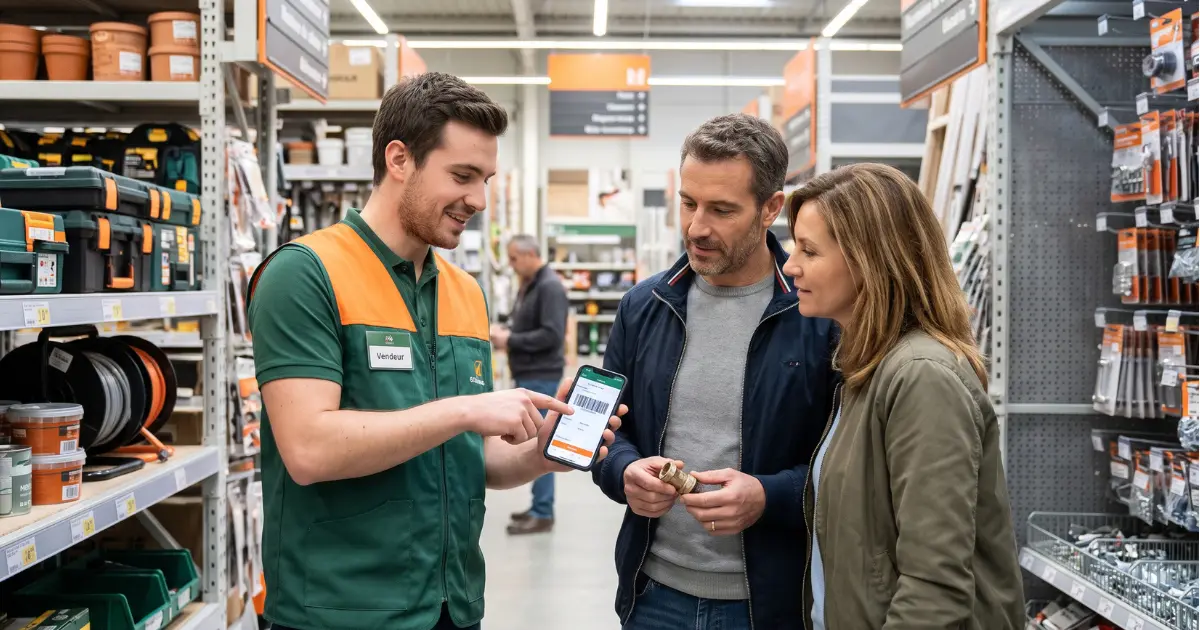

By enabling sales associates to check out customers using a tablet, smartphone, or dedicated device, mobile POS is a powerful tool for eliminating lines during peak trading hours. However, it should not be viewed merely as a portable cash register, but rather as an orchestration platform for multi-department retailers. Beyond delivering a seamless customer experience, a retail mobile POS solution simplifies daily tasks for sales associates in multiple ways: checking available inventory, applying promotions, reviewing customer purchase history, and closing sales on the spot without directing customers to a central checkout counter. However, making the right choice requires evaluating solutions against clear criteria to ensure you implement POS software that delivers true value rather than adding yet another disconnected tool to your retail ecosystem.
Why mobile POS is becoming essential for multi-department stores
As customer journeys become increasingly non-linear, fixed checkout counters are no longer sufficient during peak activity periods. A mobile POS not only reduces checkout wait times through mobility options like "Tap-to-Pay," but also empowers sales associates to take action directly on the store floor.
Sales associates can seamlessly assist shoppers anywhere in the store without interruption: offering personalized advice, checking product availability, placing orders, and handling pickups and returns. Transaction speeds increase significantly, directly enhancing the customer experience, meeting customer expectations, and preventing lost sales.
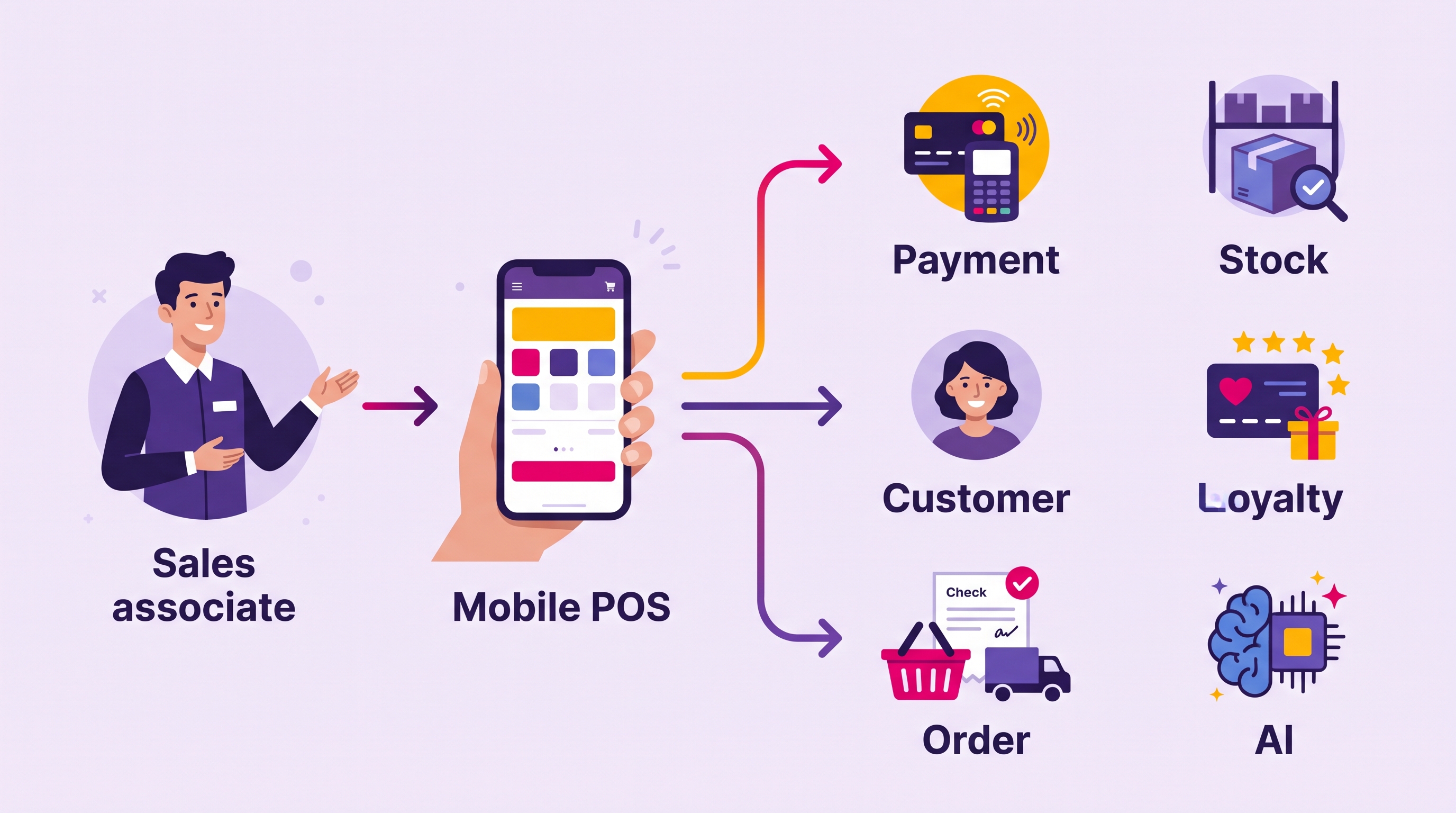
The stakes are even higher for multi-department retailers managing diverse product categories, catalogs, pricing rules, inventory pools, and services. In this context, a mobile POS serves as a unified access point for customer data, order details, and loyalty programs, all while providing real-time stock visibility.
Mobile checkout: Which technical criteria should you evaluate?
A robust technical foundation is critical to a successful mobile POS deployment. Be sure to assess these key criteria:
- Payment options: Support for Tap-to-Pay mobile payments (SoftPOS), enabling checkout without bulky hardware, subject to country compliance and payment provider capabilities.
- Offline mode and network resilience: Ability to operate offline with delayed synchronization during network outages. Offline mode is essential for store operations, especially in large retail spaces.
- Hardware compatibility: Smartphones, tablets, ruggedized devices, printers, and cash drawers where necessary.
- Payment security: Compliance with the PCI MPoC standard which establishes security requirements for solutions allowing retailers to accept PIN inputs or contactless payments on smartphones or mobile devices alongside robust permissions and authentication.
- Sales associate experience: A fast, intuitive interface tailored to store floor workflows, minimal onboarding requirements, and easy-to-carry hardware.
- Deployment and maintenance: Centralized software updates and fleet management.
- Total cost of ownership (TCO): License and hardware costs, plus expenses related to system integration, customer support, and team training.
Why checkout must be unified, not just mobile
Despite its strengths, a standalone mobile POS will not automatically transform your checkout into a growth driver especially if it operates in a silo.
Expert insight: A mobile POS shouldn't become just another isolated channel
An isolated mobile POS creates complexity. To unlock its full potential, a point of sale solution must be integrated into a unified strategy.
In practice, unified commerce checkout must share the exact same data and business rules as the rest of the retail ecosystem including fixed POS registers and e-commerce.
A centralized, real-time platform is key to bridging physical and online channels, loyalty programs, inventory management, and broader retail operations.
To deliver true unified commerce, POS software should include:
- Consistent pricing management, discounts, and promotions across fixed registers, mobile, and e-commerce.
- Clienteling and loyalty capabilities: coupons, gift cards, and customer purchase histories accessible directly on the store floor.
- Unified returns, regardless of where the purchase was made.
- Omnichannel order management: eReservations, Click & Collect, Ship from Store, and more.
- Real-time stock visibility by store, warehouse, or sales channel.
- Centralized reporting to measure and manage point-of-sale performance.

A mobile POS shouldn't become just another isolated channel.An isolated mobile POS creates complexity. To unlock its full potential, a point of sale solution must be integrated into a unified strategy.In practice, unified commerce checkout must share the exact same data and business rules as the rest of the retail ecosystem including fixed POS registers and e-commerce.A centralized, real-time platform is key to bridging physical and online channels, loyalty programs, inventory management, and broader retail operations.
To deliver true unified commerce, POS software should include:
- Consistent pricing management, discounts, and promotions across fixed registers, mobile, and e-commerce.
- Clienteling and loyalty capabilities: coupons, gift cards, and customer purchase histories accessible directly on the store floor.
- Unified returns, regardless of where the purchase was made.
- Omnichannel order management: eReservations, Click & Collect, Ship from Store, and more.
- Real-time stock visibility by store, warehouse, or sales channel.
- Centralized reporting to measure and manage point-of-sale performance.
| Feature | Unified mobile POS | Isolated mobile POS |
|---|---|---|
| Reporting | Centralized, real-time access to sales data, key metrics, and performance trends | Basic reporting and simple transaction histories |
| Integration | Automated data synchronization across retail tools and systems | High difficulty integrating POS with other systems |
| Scalability | Designed to adapt to business growth and operational complexity | Limited growth potential |
| Customer experience | Advanced personalization and optimized services across all channels | Market Guide for Unified Commerce, artificial intelligence capabilities in POS solutions are growing rapidly to enhance sales associate productivity, personalize customer interactions, and boost operational efficiency. And with good reason: a modern POS enhanced by AI unlocks numerous practical use cases:
However, despite AI's undeniable impact on retail, the technology should be viewed as an assistant to store staff rather than a silver bullet. Adding extra screens is not the end goal; the true value of artificial intelligence lies in its ability to reduce cognitive load for sales associates. Selection criteria for a multi-department retailerTo select a mobile POS that genuinely supports your retail strategy, evaluate candidate solutions against these objective criteria: Link copied!  [ Guide ] Specialised guide to selecting POS software for unified commerce  [ Guide ] Compagnies d'assurance : guide de la digitalisation FAQ Frequently asked questionsA mobile POS is a payment and sales solution operating on a smartphone, tablet, or handheld terminal. It enables sales associates to advise customers, access essential retail data, and complete transactions anywhere on the store floor. Mobile POS refers to the physical or handheld device used to process payments. Unified checkout refers to maintaining consistent pricing, promotion rules, inventory levels, customer profiles, and return processes across all selling channels. Essential criteria include true floor mobility, payment security compliance, IT system integration, real-time stock visibility, cross-channel returns, user-friendly associate experience, and centralized performance management. AI assists sales associates by recommending complementary products, retrieving item details via natural language search, suggesting out-of-stock alternatives, personalizing customer recommendations, and prioritizing key in-store tasks. Further insights Continue readingDiscover more analyses, case studies, and innovations to better understand these transformations. Your next chapter starts here. Orisha supports companies that refuse to be held back by their technology. |