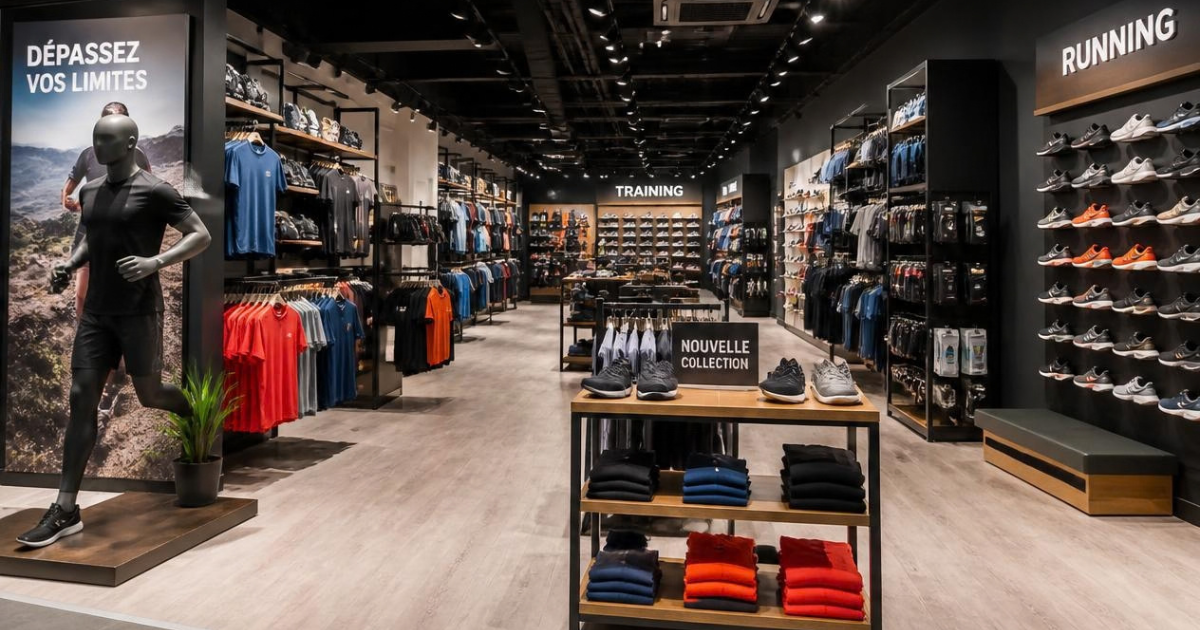


sports retail In sports retail, poor inventory management comes at a high price. Carrying too little inventory leads to lost sales, while holding too much results in markdowns, ties up working capital, and erodes margins. The challenge is that demand is notoriously difficult to forecast. Sales fluctuate based on seasonality, weather conditions, and local events—not to mention differences across store locations, sales channels, sizes, and colorways. To navigate this complexity, retailers are looking to make their purchasing, replenishment, and allocation decisions more reliable. This is where specialized solutions like Orisha Commerce (formerly Ginkoïa) deliver real value: by centralizing inventory, sales, and store data, they help businesses better anticipate demand and eliminate costly mistakes.
Why stock forecasting is difficult in sports retail
Forecasting demand for sporting goods is no easy task. The industry is driven by intense seasonality. From skiing in winter to hiking in summer, sales windows are narrow, while team sports and running follow wildly varying replenishment cycles.
This seasonality is further impacted by unpredictable weather that can boost or dampen sales in a matter of days. On top of that comes SKU proliferation: for a single running shoe or technical apparel line, inventory managers must handle a complex matrix of sizes and colors across increasingly shorter product lifecycles.
Demand also varies heavily by location. A mountain shop won't stock the same items as a downtown store. This geographic fragmentation increases the risk of stockouts on best-sellers in some stores, while the same products sit untouched in others for months.
A McKinsey report confirms this shift in the sporting goods landscape. Over the past five years, the industry's two historical giants (Nike and Adidas) lost 3 percentage points of market share to fast-growing specialist brands like Lululemon, On Running, and Arc'teryx across yoga, running, and outdoor categories.
All these factors make traditional year-over-year (Y-1) sales forecasting unreliable. To stay competitive, sports retailers need to optimize their supply chain using inventory management software that adjusts product distribution according to local realities.
How AI is transforming demand forecasting
For years, stock forecasting relied on past sales figures, buyer intuition, and historical seasonal performance. However, this traditional approach falls short when SKUs multiply, store networks expand, or sales split across brick-and-mortar stores and e-commerce. Data becomes trapped in silos across different software systems, preventing a single, reliable view of demand.
Retail AI represents a major shift: instead of looking backward, it cross-references multiple data streams in real time—actual sales, available stock levels, weather forecasts, web traffic, active promotions, product returns, recorded stockouts, local events, and supplier lead times.
Gartner estimates that by 2030, 70% of large organizations will adopt AI-driven unified inventory management systems. This major shift is fueled by the rise of touchless forecasting—automated predictions generated without manual intervention.
Traditional statistical tools are confined to historical datasets, whereas machine learning identifies complex, non-linear patterns. This makes it possible to forecast demand at the individual product level—even for new product launches or promotional campaigns with no prior sales history.
Finally, Deloitte highlights that high-performing AI models now connect demand forecasting directly with store-level execution. This aligns with Integrated Business Planning (IBP) principles, where each store's supply continually adjusts to address market fragmentation.
What real benefits can you expect?
Artificial intelligence won't magically clear out overstock or fill your shelves overnight. However, it yields tangible results: 60% of retail decision-makers state that AI tools have significantly improved the accuracy of their demand forecasting and inventory management (Deloitte).
Fewer stockouts
When an item sells faster than expected, retailers can react before a stockout occurs by tweaking reorders or transferring stock from a store with lower demand. This agility relies on real-time stock visibility—continuously updated data that lets teams spot availability gaps as early as possible.
Reduced overstock and fewer markdowns
Purchasing volumes better match actual demand across different geographic areas, sales channels, and seasons—keeping working capital from getting trapped in unsold inventory. Detecting a sales slowdown early also allows retailers to take corrective action (targeted promotions, pausing replenishment, store-to-store transfers) before excess inventory builds up.
Higher inventory turnover and seamless omnichannel execution
AI optimizes inventory turnover by placing every SKU right where it is most likely to sell. This approach ensures consistent product availability across all sales channels, with e-commerce and physical store stock levels synchronizing continuously. Retailers avoid the frustration of showing an item as available online when it is already out of stock on store shelves.
Stock accuracy is no longer just a concern for purchasing, supply chain, or store management teams—it is directly tied to customer experience. As Jessica Ifker-Delpirou noted in JDN, "you don't improve customer service by automating uncertainty." In other words, conversational AI only delivers value when backed by reliable business data: available stock, pending orders, customer history, store availability, or service status.For sports retailers, this is essential. Refining demand forecasts isn't just about reducing stockouts or overstock; it's about safeguarding your customer promise—whether shoppers check availability online, ask a store associate, or reach out to customer service.
Faster restocking and time savings
AI automates complex calculations and generates purchase order proposals ready for validation. In fact, 80% of Orisha Commerce solution users report saving up to two hours a day!
Be careful not to overpromise on AI capabilities. Success ultimately hinges on data quality. As Gartner reminds us, the foundation of any successful AI initiative is reliable, well-structured data.Before deploying sophisticated algorithms, retailers should focus on streamlining their data collection, centralization, and governance processes.
Priority use cases for sports retailers
Here are four real-world use cases commonly seen in sports retail. These applications become even more powerful when inventory and sales data are unified within a single information system.
- Forecasting demand by size and shoe size
Running shoes and technical apparel perfectly highlight this forecasting challenge. A product reference might show adequate overall stock levels while key sizes are completely out of stock. Predictive analytics for inventory management help pinpoint the most demanded sizes, enabling buyers to tailor replenishment to actual consumer needs. - Anticipating seasonal and weather spikes
A sudden cold snap, heavy snowfall, or back-to-school sports season can dramatically alter sales in a matter of days. By factoring in weather and seasonal trends, predictive models help teams spot demand shifts early and adjust inventory thresholds accordingly. - Optimizing store allocation
Every store location serves a distinct customer base with unique requirements. An item that sells out rapidly in one location might sit in the backroom for weeks in another. The goal is to allocate inventory directly to where demand is highest. - Minimizing unsold stock before season end
The sooner teams detect a sales slowdown, the easier it is to organize store-to-store transfers, adjust pending supplier orders, schedule targeted promotions, or pause restocking to prevent unsold inventory from piling up.
This logic ties directly back to a core requirement: before automating forecasting, product recommendations, or customer interactions, retailers must first ensure their inventory, sales, product, and store data are completely reliable.
Prerequisites for deploying AI
AI cannot fix incorrect, incomplete, or poorly structured information. No matter how advanced an algorithm is, it cannot compensate for poor data quality.
Before deploying an AI-assisted forecasting solution, ensure your data is clean, reliable, available, and accessible. Otherwise, your forecasts risk being less accurate, harder to explain, and difficult to act upon.
Quick checklist: are you ready for AI forecasting?
- Store inventory is accurate.
- Product master data is clean and up to date.
- Historical sales data is usable.
- E-commerce data is fully integrated.
- Product returns are properly tracked.
- Recorded stockouts are logged.
- Data is available at the SKU level.
- Data is available at the store level.
- Data is available by sales channel.
- Business rules (alert thresholds, safety stock) are validated by teams.
Note: These prerequisites are essential for training and powering forecasting models. Without them, algorithms will simply automate errors at scale, escalating the risk of stockouts or overstocking rather than optimizing inventory.
AI and stock forecasting: key KPIs to track
The primary goal of AI-assisted forecasting is to boost operational performance. Today's consumers pay close attention to product pricing and availability, forcing retailers to strike a delicate balance between cost control, inventory levels, and service quality (Deloitte).
To verify that your inventory is better proportioned, stockouts are declining, and products flow smoothly across channels, six key KPIs deserve close attention.
AI-assisted stock forecasting brings true value to sports retailers when tied to a clear operational problem. The real ROI doesn't come from the algorithm alone, but from connecting inventory, sales, e-commerce, and store data directly with daily business execution.